
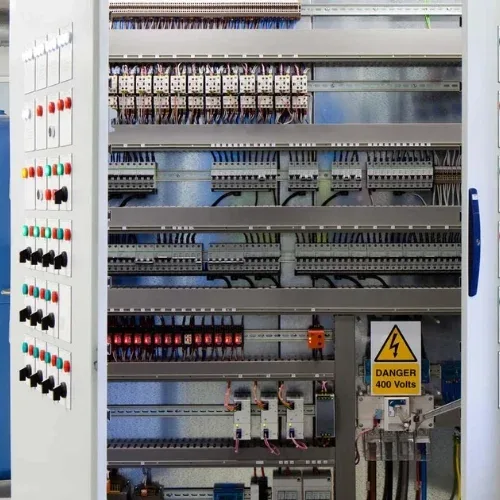
Many industrial machines require motors to operate at different speeds depending on the process. Running every motor continuously at a fixed speed may not always be suitable for applications such as pumps, fans, conveyors, blowers and compressors.
A VFD Panel provides a controlled arrangement for operating compatible AC motors through a Variable Frequency Drive. By controlling the electrical frequency and voltage supplied to the motor, the system can provide adjustable motor speed and flexible process operation.
This guide explains what a VFD Panel is, how it works, its main components, applications, benefits and important factors to consider when selecting one.
What Is a VFD Panel?
A VFD Panel is an electrical control panel that incorporates a Variable Frequency Drive for controlling the operating speed of a compatible motor.
The VFD adjusts the electrical supply characteristics provided to the motor according to the required operating conditions. This allows the motor to operate at variable speeds instead of relying only on fixed-speed operation.
A typical VFD system can be designed according to:
- Motor capacity
- Input voltage
- Drive selection
- Output requirements
- Control method
- Cooling arrangement
- Protection requirements
- Installation environment
The final configuration depends on the motor, process and electrical system requirements.
How Does a VFD Panel Work?
A Variable Frequency Drive Panel uses a variable frequency drive to control the frequency and voltage supplied to a compatible AC motor.
The basic operating concept can be understood as:
Incoming Power → VFD → Controlled Electrical Output → AC Motor
By adjusting the operating frequency, the drive can control motor speed according to the requirements of the application.
This is particularly useful where equipment needs different operating speeds during different stages of a process.
For applications where multiple motors need centralized control and protection, a MCC Panel can work alongside a VFD system.
Main Components of a VFD Panel
The exact configuration varies according to the project, but a VFD Drive Panel can include several important components.
Variable Frequency Drive
The VFD is the primary control component responsible for regulating the operating characteristics of the compatible motor.
Protection Components
Suitable electrical protection can be incorporated according to the motor, drive and overall electrical system requirements.
Control Components
Control components can be configured for local, remote, automatic or process-based motor operation.
Cooling Arrangement
VFD equipment generates heat during operation, so suitable natural or forced ventilation can be provided according to the panel configuration and operating conditions.
Key Benefits of a VFD Control Panel
A properly designed VFD Control Panel can provide useful advantages for suitable industrial applications.
Adjustable Motor Speed
Motor speed can be adjusted according to process or equipment requirements.
Better Process Control
Variable speed operation allows motor performance to be aligned with changing process requirements.
Smooth Motor Operation
Controlled starting and operating conditions can help provide smoother motor operation in suitable applications.
Reduced Mechanical Stress
Controlled motor starting and operating conditions can help reduce mechanical stress on connected equipment.
Operational Flexibility
Variable speed operation can be useful for pumps, fans, conveyors, blowers, compressors and other motor-driven equipment.
Applications of VFD Panels
VFD Panels are used across many industrial applications where adjustable motor speed or controlled operation is required.
Common applications include:
- Water treatment plants
- HVAC systems
- Pumping stations
- Food processing
- Pharmaceutical industries
- Chemical industries
- Textile industries
- Conveyor systems
- Compressors
- Fans and blowers
- Cement plants
- Manufacturing industries
For plants requiring centralized automation and process monitoring, a PLC SCADA Panel can complement the VFD-based motor-control system
How to Select the Right VFD Panel?
Selecting the right VFD Panel Manufacturer and configuration requires understanding both the motor and the application.
Motor Capacity
The motor rating should be identified before selecting the appropriate drive.
Input Requirements
Input voltage and electrical supply characteristics should be considered during panel design.
Drive Selection
The VFD should be selected according to motor characteristics and required operating conditions.
Cooling Requirements
The required cooling arrangement depends on the drive, enclosure and operating environment.
Protection
Suitable protection should be considered for the motor, drive and electrical system.
Control Method
Determine whether the motor requires local, remote, automatic or process-based control.
Enclosure
The enclosure and protection level should match the installation environment.
VFD Panel vs Conventional Motor Control
A conventional motor-control arrangement generally operates a motor according to fixed operating conditions, while a VFD-based system allows the motor speed to be adjusted according to process requirements.
A VFD system can therefore be useful where equipment requires:
- Variable operating speeds
- Controlled acceleration
- Controlled deceleration
- Process-based speed adjustment
- Flexible motor operation
The actual suitability depends on the motor, equipment and application requirements.
For broader industrial power distribution, a Power Panel can work as part of the overall electrical infrastructure.
Why Choose a Customized VFD Panel Manufacturer?
Every application can have different motor ratings, operating conditions, control requirements and installation environments.
A suitable VFD Panel Manufacturer can configure the panel according to:
- Motor capacity
- Input requirements
- Drive selection
- Enclosure type
- Cooling arrangement
- Protection requirements
- Control method
- Installation conditions
Bull Industries develops customized VFD Panels according to motor requirements, electrical system configuration and application-specific operating conditions. The current product configuration supports suitable drive options including ABB, Siemens, Schneider, Delta and others according to project requirements.
For centralized industrial power distribution and feeder management, a PCC Panel can also be part of the wider electrical system.
Frequently Asked Questions
What is a VFD Panel?
What is a VFD Control Panel used for?
What is a VFD Drive Panel?
What are the benefits of a VFD Panel?
Where are VFD Panels used?
Can a VFD Panel be customized?
Conclusion
A VFD Panel provides a practical solution for applications requiring adjustable motor speed and controlled operation. By incorporating a Variable Frequency Drive with suitable protection, control and cooling arrangements, the system can be configured around the requirements of different industrial processes.
From pumps and fans to conveyors, compressors and manufacturing equipment, a properly selected VFD system can provide greater operational flexibility where variable-speed motor control is required.
Choosing an experienced VFD Panel Manufacturer can help ensure that the drive, motor, protection, cooling, enclosure and control configuration are properly matched to the application’s electrical and operating requirements.